Display technology is more than cabinet brightness. The practical system includes calibration discipline, processor architecture, remote health monitoring, content permissions, and documentation that lets operators keep a visual network stable under pressure.
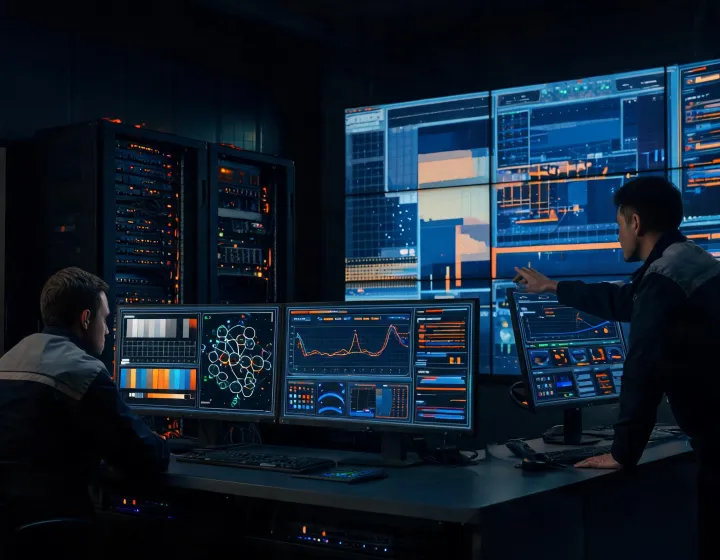
A technical LED display package should show how image quality, network status, environmental conditions, and response procedures will be governed after commissioning. These dashboard-style indicators turn the technology discussion into measurable operating behavior.
For sizing conversations, the dashboard typically anchors on four measurable bands: pixel pitch from roughly 1.2 mm for control-room and lobby fine-pitch walls up to 10 mm for long-throw venue boards; outdoor luminance in the 5,000-10,000 nits range against 600-1,200 nits indoors; an IP65-rated front face for exposed exterior cabinets; and a 1,920-3,840 Hz refresh class for broadcast-safe capture. Each number is a planning band, not a fixed promise, and the right value depends on viewing distance and camera presence.
Most LED display debates are not "which brand," they are trade-offs between competing engineering priorities. The honest answer is that no single configuration wins every metric, so a venue board, a control-room wall, and a retail facade legitimately land on different sides of the same questions.
Tighter pixel pitch (1.2-2.5 mm) sharpens near-view text but uses smaller LEDs that cap peak luminance and raise per-square-metre cost. Wider pitch (6-10 mm) drives the high nits a sunlit stadium needs, at the expense of close-up resolution. The audience distance, not the spec sheet, should decide where you sit on this curve.
Front-service cabinets shorten maintenance time in tight wall-mounted installs but add depth and cost per module. Rear-service is leaner where a catwalk or service corridor already exists. Choosing the wrong one is one of the most expensive errors to correct after the wall is closed.
Transparent mesh (typically 50-90% see-through) preserves storefront daylight and sightlines, but trades away brightness, contrast, and content density. A solid wall delivers full image punch yet blocks the glass it covers. Retail and architectural projects feel this tension most.
A 3,840 Hz refresh class removes scan lines on broadcast cameras and reduces flicker fatigue, but the driver electronics cost more and draw more power. A venue with no live broadcast can responsibly accept a lower refresh band and reinvest that budget in redundancy or spares.
An authority-grade technical brief names the constraints, not only the capabilities. These are the limits we expect serious buyers to plan around rather than discover after handover.
The strongest projects document the reasoning behind pixel pitch, processor topology, brightness scheduling, and service model. The downloads below are framed as the kind of engineering artifacts stakeholders expect during a capital approval process.
Document brightness, pixel pitch, power, mounting, and control assumptions with enough detail for procurement and code review teams.
Confirm cabinet, controller, and content workflow readiness before installation teams begin closing walls or ceilings around the system.
Capture calibration, signal, monitoring, and failover results so the owner receives an auditable baseline.
Maintain update procedures, spare strategy, escalation contacts, and content permissions as the display network evolves.
Send the application, screen dimensions, content source plan, and expected operating hours. The response can focus on technology choices that change ownership risk.